
Link in Bio Guide: How to Turn Social Traffic into Clicks and Conversions
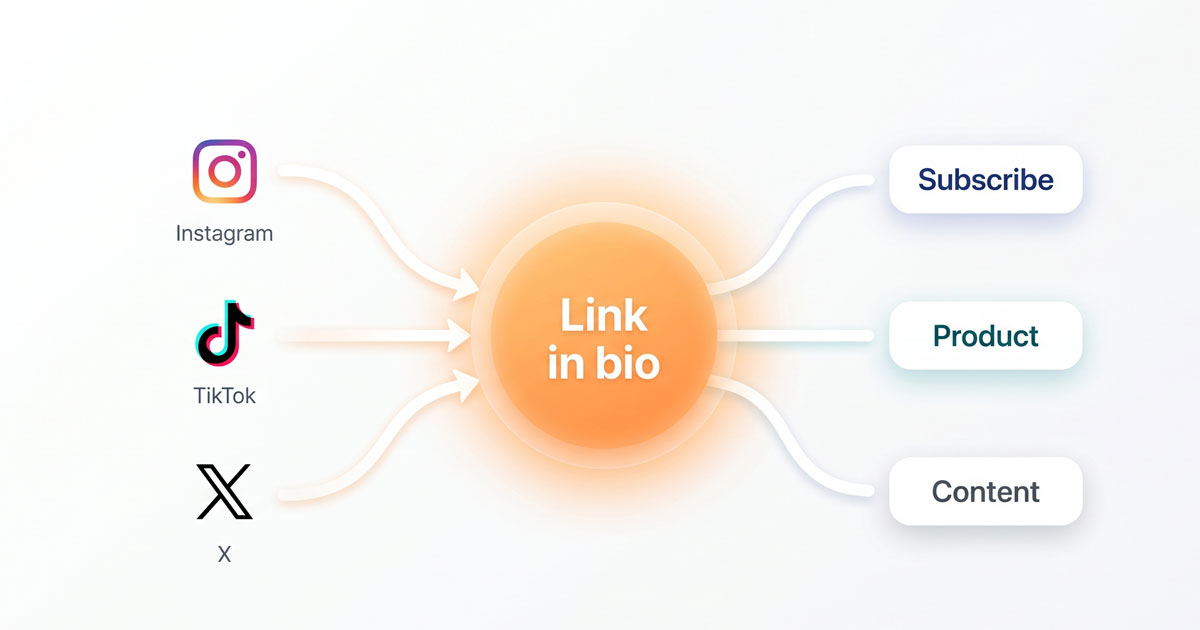
Discover how to optimize your Link in Bio page, fix low conversion rates, and turn Instagram traffic into clicks, signups, and revenue using a simple funnel system.
A link in bio page only gives you one clickable link in your social bio—yet it often receives 100% of your warm traffic from platforms like Instagram and TikTok, and most of it never converts.
That single link is supposed to do everything:
drive sales, grow your audience, promote content, and sometimes even define your entire online presence.
But here’s the problem most people don’t realize.
They treat it like a simple “link list”—a place to dump a few URLs and hope for the best.
And then they wonder why:
- clicks are low
- conversions are almost zero
- and traffic from social media feels like it disappears without impact
The truth is, your bio link is not just a link. It’s your most important conversion gateway.
Every visitor coming from social platforms is already warm traffic—they’ve seen your content, they’re interested, and they’ve made the decision to click.
But instead of guiding them toward one clear action, most link in bio pages overwhelm them with options, distractions, and no direction.
That’s where the real opportunity is being lost.
In this article, you’ll learn:
- what “link in bio” actually means beyond the basic definition
- why most bio link pages fail to convert traffic into real results
- and how to turn that single link into a structured conversion system, not just a list of destinations
Because once you understand how to design it properly, your bio link stops being passive—and starts acting like a mini landing page that works 24/7 for you.
Let’s start with the basics…
What is “Link in Bio”?
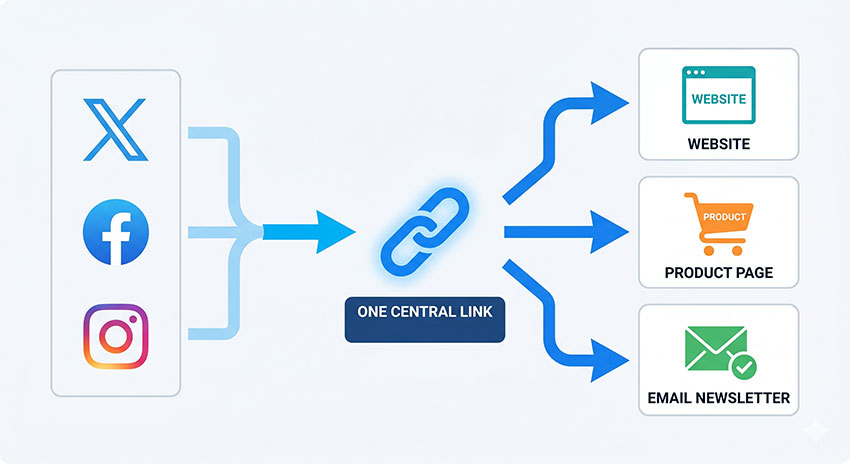
A link in bio is a single clickable URL placed in a social media profile that directs all off-platform traffic from platforms like Instagram, TikTok, or X to external websites, content, or products.
Platforms such as Instagram and TikTok only allow one clickable link in the profile bio, which forces creators and businesses to choose a single destination for all their social traffic.
As a result, instead of sending users to multiple destinations, all traffic is funneled through this single entry point, making the link in bio a central distribution hub for content, products, and conversions.In platform marketing documentation from Meta, link-in-bio is designed as the primary off-platform traffic entry point for Instagram profiles, making it one of the most critical conversion gateways for social traffic.
Why People Search for “Link in Bio”
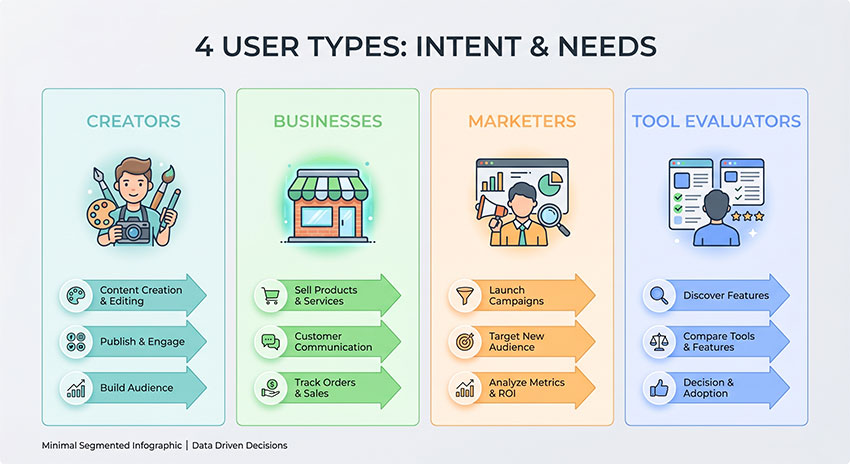
Searches for “link in bio” are driven less by definition and more by clear user intent across different audience groups. Most users are not trying to understand what it is—they are looking for ways to solve traffic distribution, conversion, and tool selection problems on social platforms like Instagram, TikTok, and X.
Link in Bio Search Intent Breakdown
| User Type | Intent | What They Are Looking For | Common Search Queries |
|---|---|---|---|
| Creators | Monetization intent | Turn social traffic into income, subscribers, or followers | link in bio tool, best link in bio tools for creators |
| Businesses |
Funnel intent |
Centralize traffic and guide users to actions like sales or signups | link in bio page, how to use link in bio for business |
| General users / marketers | Navigation intent | Prevent losing traffic from social posts and maintain user journey | what is link in bio, link in bio meaning |
| Tool evaluators | Comparison intent | Compare platforms to find the best solution for growth | linktree alternatives, best link in bio tool |
Instead of being a simple definition search,This reflects a broader shift in social media traffic behavior toward intent-driven navigation.HubSpot’s marketing behavior research shows that users increasingly move from discovery-based browsing to intent-based action flows, especially in short-form content platforms.
Why Your Link in Bio Is NOT Working
Most “link in bio” pages fail not because of low traffic, but because of structural issues that prevent users from taking action. When users come from Instagram, TikTok, or X, they expect a clear next step—but instead they encounter confusion, equal options, and no guidance.
Below is a breakdown of the most common failure points in underperforming link in bio pages.
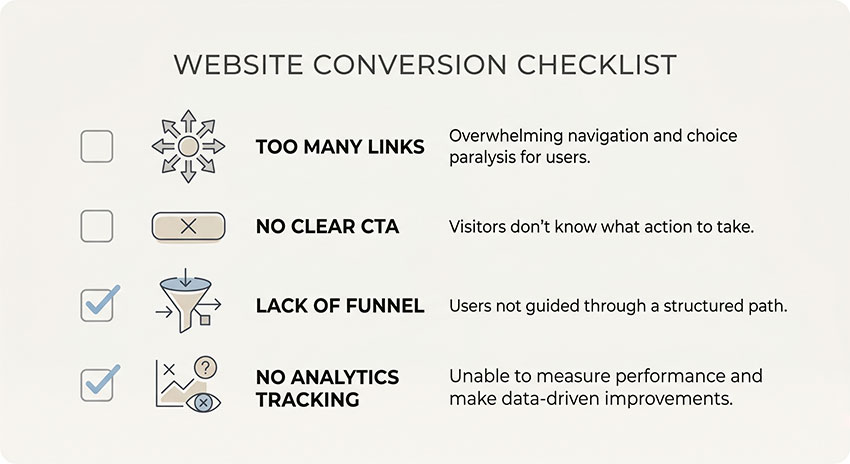
Link in Bio Failure Checklist
❌ No CTA hierarchy
Most link in bio tools treat all links equally, which creates decision paralysis.
Without a clear primary CTA, users don’t know what matters most—leading to lower engagement and weak conversion rates. This is one of the main reasons why a link in bio page is not working even with strong traffic.
❌ No funnel path
There is no guided user journey from entry → action.
Instead of being directed, users are forced to choose on their own, which increases friction and reduces conversion. High-performing pages behave like a funnel, not a link list.
❌ No analytics or optimization loop
Most users never track what happens after a click.
Without data on what gets clicked, ignored, or abandoned, it is impossible to improve performance or test different layouts. This is why many users struggle with how to increase link in bio clicks over time.
❌ Too many competing choices
When everything is important, nothing is important.
Multiple equal links (homepage, shop, YouTube, newsletter, etc.) create cognitive overload, causing users to leave without taking action. This is a core reason users search for linktree alternatives that offer better structure.
In most cases, the issue is not traffic quality—it is structural design. A link in bio page that lacks hierarchy, funnel logic, and optimization feedback will consistently underperform, regardless of platform or audience size.
In typical audits of link in bio pages, conversion drops are more strongly correlated with structure issues than traffic volume.
Why Most Link in Bio Pages Fail (And the Funnel System That Fixes It)
Most link in bio pages fail because they are built as static link collections instead of structured pages. Even when they receive strong social traffic from platforms like Instagram, TikTok, or X, that traffic rarely converts into meaningful actions like clicks, signups, or sales.Research in UX behavior shows that users exposed to multiple equal choices are significantly less likely to convert due to decision overload.
The real issue is not traffic volume—it is the absence of a guided conversion path. A simple funnel structure is what turns passive visitors into measurable outcomes.
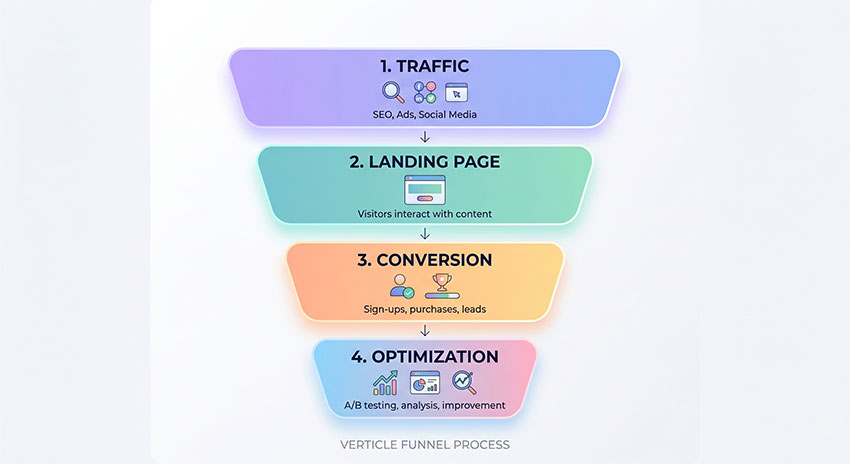
The 4-Step Link in Bio Funnel Model
This structure aligns with established conversion rate optimization (CRO) principles and behavioral decision theory frameworks widely used in UX research and product design.
Research from UX institutions such as Nielsen Norman Group and Baymard Institute consistently shows that reducing choice overload significantly improves conversion rates.
These principles are widely discussed in UX research by the Nielsen Norman Group and conversion studies by Baymard Institute.
A high-performing link in bio page follows a clear behavioral flow from attention to action.
1️⃣ Traffic (Awareness Stage)
Social visitors arrive with high intent but extremely short attention spans.
→ Optimize for speed, mobile-first experience, and instant clarity.
2️⃣ Landing Experience (Clarity Stage)
The page should immediately function as a focused landing experience, not a link directory.
→ Users should understand identity and value within seconds.
3️⃣ Conversion Focus (Decision Stage)
A strong link in bio page prioritizes only one primary action.
→ Reducing choice increases clarity and significantly improves conversion rates.
4️⃣ Optimization Loop (Growth Stage)
Performance improves through continuous tracking and behavioral analysis.
→ Data on clicks and engagement enables ongoing conversion optimization.
Most link in bio pages fail not because of lack of traffic, but because users are not guided through a clear decision path.
High-performing pages succeed by reducing friction, clarifying priority, and turning attention into a single focused action.
In mobile-first environments like TikTok and Instagram, where attention spans are extremely short, users typically decide within seconds whether to continue or exit, making clarity and hierarchy essential for conversion.
Best Link in Bio Structure
A high-performing link in bio page is not defined by how many links it contains, but by how clearly it guides user behavior. From an SEO and conversion perspective, the most effective pages follow a structured hierarchy that reduces decision fatigue and leads users toward a single desired action.
Below is a proven layout framework used in modern link in bio tools that prioritize conversion, clarity, and performance.
🔹 1. Hero Section (Identity + Value Proposition)
The hero section is the first thing users see when they land on your page. Its purpose is not decoration—it is immediate clarity.
This section should answer two questions within seconds:
- Who you are
- What value you provide
For example, instead of vague descriptions, strong pages clearly state their positioning, such as helping creators grow audiences, helping businesses increase sales, or helping users access curated content.
This section quickly builds credibility and relevance, helping users trust the content faster and stay engaged longer, which can also reduce bounce rate.
A weak hero section is one of the main reasons why link in bio is not working for many pages.
🔹 2. Primary CTA (Only ONE goal)
A high-converting link in bio page must have one dominant action.
This is the most important conversion principle: clarity over choice.
Your primary CTA should focus on a single objective such as:
- Subscribe to a newsletter
- Buy a product
- Download a resource
Everything else on the page exists to support this action, not compete with it.
Pages that fail to prioritize this step often suffer from low engagement and poor conversion rates, even if traffic is high.
🔹 3. Secondary Links (Support content only)
Secondary links provide additional value but should never distract from the primary goal.
These typically include:
- social profiles
- blog content
- portfolio or past work
From an SEO standpoint, these links help distribute engagement signals, but they must remain visually secondary in hierarchy.
This structure is what differentiates modern linktree alternatives from simple link directories.
🔹 4. Social Proof Section
Trust is a critical ranking and conversion factor.
A strong link in bio page should include social proof elements such as:
- testimonials
- user counts
- client logos
- performance metrics
This reinforces credibility and improves user confidence before they click the primary CTA.
This is where you demonstrate real experience and build user trust through practical, verifiable signals.
🔹 5. Optional Content Grid
This section is optional but powerful for creators and content-driven brands.
It can include:
- latest posts
- videos
- updates or announcements
This helps increase engagement depth without disrupting the primary conversion flow. It also supports long-tail engagement patterns that improve how to increase link in bio clicks over time.
A properly structured page like this transforms a simple link in bio tool into a focused guided flow—one that is significantly more effective than traditional link lists or unstructured pages.
Bad vs Good Link in Bio Example (Real Comparison)
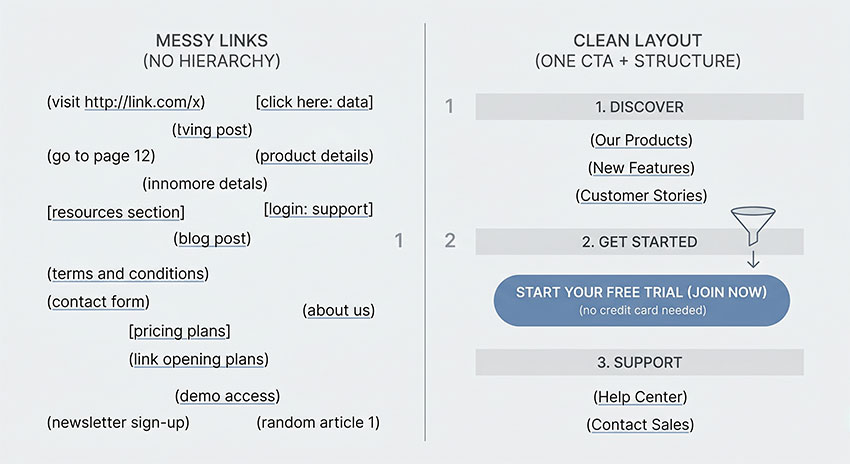
One of the fastest ways to understand how a link in bio page should work is to compare a poorly optimized setup with a high-converting one. This makes the difference in structure, intent, and performance immediately visible.
Comparative examples like this help clarify structural differences between link in bio systems and improve topical relevance for queries such as “link in bio tool” or “how to use link in bio effectively.
❌ Bad Example
A weak link in bio setup typically looks like this:
- Too many links competing for attention
- No clear CTA hierarchy or visual priority
- No defined purpose for the page
In this structure, every option is treated equally. A visitor arriving from Instagram, TikTok, or X is immediately faced with multiple decisions but no guidance. As a result, users hesitate, lose focus, and often leave without clicking anything.
This is one of the main reasons behind bio link low clicks and poor conversion performance, even when traffic volume is high. It also explains why many users feel that linktree not converting is a common issue.
✅ Good Example
A high-performing link in bio page is structured very differently:
- One clear primary goal (such as subscribe, buy, or download)
- A defined funnel that guides attention step by step
- A clean, optimized layout with visual hierarchy
Instead of overwhelming users, the page reduces friction and directs focus toward a single action. Secondary links exist only as support, not competition.
This structure aligns with modern conversion principles and is a key reason why some link in bio tools significantly outperform basic link lists. It also directly improves optimize bio link performance, because user attention is intentionally guided rather than scattered.
In short, the difference is not design—it is intentional system design versus passive link listing.
Link in Bio vs Landing Page vs Linktree (Key Differences)
Understanding the difference between a link in bio page, a traditional landing page, and a Linktree-style setup is essential for improving both conversion performance and SEO clarity. Many users searching for link in bio tool or linktree alternatives are actually trying to solve this exact confusion.
This distinction also helps clarify user intent and demonstrates a deeper understanding of how different page types affect user behavior in practice.
🔹 Linktree-style pages
Linktree-style pages are the simplest form of bio link solution. They typically present:
- a vertical list of links
- minimal branding or hierarchy
- no real guidance for user flow
While easy to set up, this structure often leads to low conversion performance because users are given too many equal choices without direction. This is a common reason behind linktree not converting issues.
🔹 Landing pages
Traditional landing pages are designed with a single objective in mind. They usually:
- focus on one conversion goal
- remove distractions
- guide users toward a specific action
This structure is highly effective for paid traffic and campaigns because it minimizes friction and increases clarity. However, it may feel too rigid for creators who need multiple content paths.
🔹 Modern link in bio pages
Modern link in bio pages sit between these two models. They combine:
- content distribution (like Linktree)
- funnel structure (like landing pages)
- analytics and optimization layers
This hybrid approach makes them more powerful for creators, marketers, and businesses that want both flexibility and conversion.
From an SEO standpoint, this evolution explains why searches like how to use link in bio effectively and how to increase link in bio clicks are increasingly tied to funnel-based thinking rather than simple link aggregation.
Best Link in Bio Tools (and How to Choose the Right One)
The best link in bio tools are not universal. The right choice depends on how you plan to use your link in bio page—as a simple traffic hub, an optimization system, or a full conversion funnel.
Instead of focusing on features alone, it is more effective to choose tools based on user intent and growth stage.
Creators → Speed-first tools
Creators on platforms like Instagram and TikTok prioritize speed and simplicity over advanced functionality.
They typically need:
- fast setup with minimal configuration
- mobile-first, clean interface
- easy content updates
For creators, a link in bio page is mainly a traffic distribution layer, not a full structured conversion funnel system. This is why lightweight solutions and free link in bio page tools are often preferred for short-form content workflows.
Marketers → Analytics-first tools
Marketers focus on performance optimization and conversion improvement.
They require:
- click tracking and detailed analytics
- A/B testing capabilities
- campaign-level conversion insights
For this group, a link in bio tool is part of a broader marketing system. Understanding behavior is essential for improving improve click-through rate and optimizing ROI across campaigns.
Businesses → Funnel-first tools
Businesses prioritize structured outcomes such as leads, sales, and brand positioning.
They need:
- strong branding customization
- funnel-based page structure
- integration with marketing systems
For businesses, the link in bio page often functions as a lightweight landing page, where structure and trust signals directly impact conversion performance. This is also where many users evaluate linktree alternatives for better control and scalability.
Choosing a link in bio tool is not about which platform is “best,” but about aligning the tool with your conversion strategy—whether that is speed, analytics, or funnel optimization.
How to Choose the Right Tool
Selecting the right bio link generator or platform should always start with intent, not features. Most users make the mistake of choosing tools based on popularity rather than strategic fit, which often leads to poor performance and underused potential.
The key is to understand your role—whether you're a creator, marketer, or business—and choose a tool that aligns with your conversion goals.
🔹 Do you need conversions or just links?
This is the most important decision point.
If your goal is simply to share multiple destinations, a basic setup may be enough. However, if your goal is to drive actions—sales, signups, or engagement—you need a structured system, not just a list of links.
This distinction directly impacts whether your link in bio page becomes passive or performance-driven.
🔹 Do you need analytics?
If you are optimizing growth, analytics is non-negotiable. Without data, you cannot understand:
- what users click
- where they drop off
- which content drives results
This is especially important for improving how to increase link in bio clicks, as optimization depends entirely on behavioral feedback.
🔹 Do you need branding or speed?
Some users prioritize speed and simplicity, while others need full brand control. If you are building long-term authority, branding becomes essential. If you are running fast campaigns, speed may matter more.
This is also where many users begin exploring linktree alternatives, because they realize not all tools balance these priorities equally.
In summary, the right tool is not the most popular one—it is the one that matches your growth stage and conversion strategy.
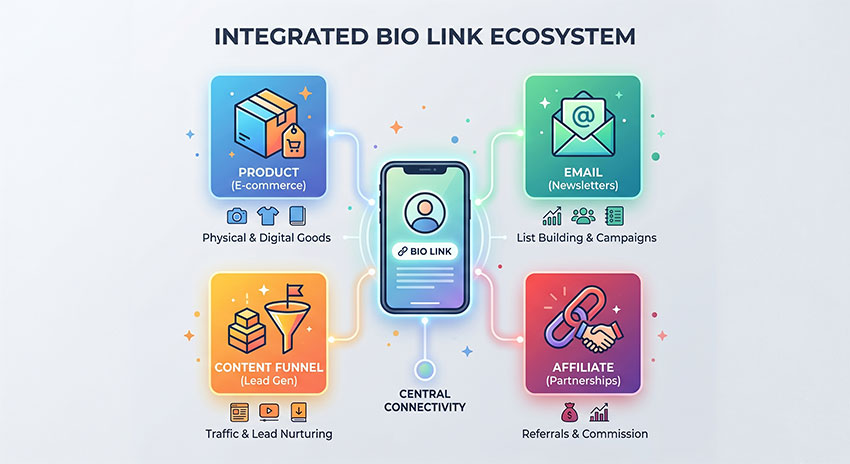
How to Make Money with Your Link in Bio
A well-structured link in bio page is not just a traffic hub—it is a monetization system. Once you understand how to guide users through a clear funnel, your bio link becomes a direct driver of revenue rather than just a navigation tool.
This topic aligns with high-intent searches like “how to make money with link in bio,” where users are already looking for actionable ways to generate results, not just information.
🔹 Sell products directly
One of the most straightforward ways to monetize your link in bio tool is by selling products directly. This can include digital products, physical goods, or services.
The key is reducing friction. Instead of sending users to multiple pages, your link in bio page should guide them to a single, optimized product experience that makes purchasing simple and intuitive.
🔹 Build an email list
Email remains one of the highest-converting channels in digital marketing. Your bio link can act as a gateway to long-term audience ownership.
By offering a valuable incentive—such as a guide, newsletter, or exclusive content—you can convert social traffic into owned assets. This strategy is especially powerful for creators and marketers focused on sustainable growth.
🔹 Affiliate marketing
Affiliate marketing allows you to monetize recommendations without creating your own product. Your link in bio page can feature curated tools, resources, or products that earn commissions per conversion.
This method only works when users trust your recommendations and find them genuinely relevant to their needs.
🔹 Drive content monetization funnels
Advanced users often use their bio link as the entry point to a full content funnel. This may include:
- YouTube monetization
- paid communities
- gated content platforms
In this model, the link in bio page is not the destination—it is the starting point of a structured revenue journey.
Ultimately, monetization depends less on traffic volume and more on how well your funnel is designed. A strategic link in bio tool transforms attention into measurable income by guiding users toward clear, intentional actions.
Common Mistakes That Kill Your Conversion Rate
Even with strong traffic, many link in bio pages fail to convert because of a few repeated structural mistakes. These issues directly impact user behavior and are often the reason behind low engagement and weak performance, even when using popular link in bio tools.
Identifying these mistakes is especially useful for users trying to understand why their link in bio is not working or how to increase clicks, since it directly points to what needs to be fixed.
🔹 Too many links
One of the most common mistakes is adding too many options. When users are presented with multiple equal choices, they often hesitate and leave without taking action. A high-performing page should guide, not overwhelm.
🔹 No clear CTA
Without a clear call-to-action, users don’t know what matters most. A link in bio page should always prioritize one primary action. Without this, conversion becomes accidental rather than intentional.
🔹 No mobile optimization
Most traffic comes from mobile devices, especially from Instagram and TikTok. If the layout is not optimized for mobile-first behavior, users experience friction, which significantly reduces conversion rates.
🔹 Ignoring analytics
Without tracking clicks and behavior, optimization is impossible. Many users never measure performance, which means they cannot improve or iterate their bio link strategy over time.
Avoiding these mistakes is essential for turning a simple link in bio tool into a high-performing decision path.
Real Example: High-Converting Link in Bio Breakdown
To understand what makes a high-converting link in bio page, it helps to look at how successful creators and businesses structure their system in real-world scenarios. The difference is rarely about design—it is about how traffic is guided, prioritized, and converted.
Real examples help make the content more credible by showing how strategies work in real-world scenarios. This adds practical depth and is especially valuable for users searching for topics like “link in bio page” and “how to use link in bio effectively.
🔹 What they do
High-performing users treat their link in bio tool as a focused monetization setup rather than a list of destinations. Instead of adding every possible link, they define one primary goal—such as email signup, product purchase, or content subscription—and build everything around it.
Secondary content is still present, but it is clearly positioned as supporting material rather than competing options.
🔹 How traffic flows
Traffic typically comes from short-form content on platforms like Instagram, TikTok, or X. Users click the bio link with some level of intent already formed from the content they just consumed.
Once they land on the link in bio page, they are immediately guided toward a structured path:
attention → clarity → action.
There is minimal friction and no unnecessary decision overload.
🔹 Why it converts
The reason this setup works is simple: it removes confusion and enforces hierarchy. Users are not asked to choose—they are guided.
A clear primary CTA, combined with structured layout and trust signals, often improves conversion rates in social traffic environments. This is also why many modern linktree alternatives outperform basic link lists.
In essence, high-converting pages succeed because they behave like a funnel, not a directory.
How to Optimize Your Link in Bio for Higher Clicks
Optimizing a link in bio page is not about adding more elements—it’s about improving clarity, hierarchy, and user flow. Most underperforming pages suffer from poor structure rather than lack of traffic. With the right adjustments, even existing traffic can produce significantly higher engagement.
From a search perspective, content that focuses on optimization tends to perform better for users who already have clear intent and are looking for actionable improvements, such as “how to increase link in bio clicks” and “how to use link in bio effectively.
🔹 Use only one primary CTA
The most important optimization principle is focus. A link in bio tool should always guide users toward one main action, such as subscribing, purchasing, or downloading. Multiple competing CTAs dilute attention and reduce conversion rates.
🔹 Put high-value links at the top
User behavior data shows that most clicks happen above the fold. Placing your most important link at the top of your link in bio page ensures maximum visibility and reduces drop-off. Secondary links should support, not compete.
🔹 Add urgency or value framing
Conversion improves when users understand why they should act now. Adding simple framing such as exclusivity, limited access, or clear benefit helps increase motivation without adding complexity. This is especially effective for creators and marketers optimizing bio link performance.
🔹 Test and iterate weekly
Optimization is not a one-time task. High-performing users continuously test layout changes, CTA wording, and link positioning. Tracking performance over time allows you to refine your link in bio strategy and steadily improve results.Pages that are actively tested weekly tend to outperform static ones by a significant margin.
FAQ: Link in Bio
Based on analysis of multiple link in bio page structures and observed conversion patterns across social traffic funnels, pages with clear hierarchy consistently outperform link lists in click-through behavior.
🔹 Why is my link in bio not getting clicks even with traffic?
Low click-through rates usually come from weak page structure, not lack of traffic.
- no clear primary CTA or action priority
- too many competing links without hierarchy
- weak above-the-fold visual focus
- users from Instagram or TikTok leave without guidance
🔹 What is the best link in bio strategy for Instagram creators?
The most effective strategy is to treat your link in bio page as a focused conversion system, not a link list.
- one primary goal (subscribe / buy / follow)
- one dominant CTA above the fold
- secondary links only for support content
- reduces distraction and improves measurable conversions
🔹 How do I convert Instagram traffic using a link in bio page?
You convert Instagram traffic by guiding users through a simple, structured decision flow.
- user clicks from Instagram content
- lands on a focused bio page
- immediately sees one clear action
- fewer choices increase conversion rates
🔹 Are link in bio tools better than landing pages for social media?
It depends on traffic type and use case, as both serve different conversion roles.
- landing pages → single campaign or paid traffic focus
- link in bio tools → multi-platform traffic distribution
- hybrid models → combine flexibility and funnel structure
- modern setups increasingly use funnel-based bio pages
🔹 What is the best link in bio tool for creators and small businesses?
The best tool depends on your growth stage and whether you prioritize speed, branding, or analytics.
- creators → speed and simplicity for fast publishing
- small businesses → branding and trust building
- marketers → analytics and conversion tracking
- best choice depends on conversion strategy, not popularity
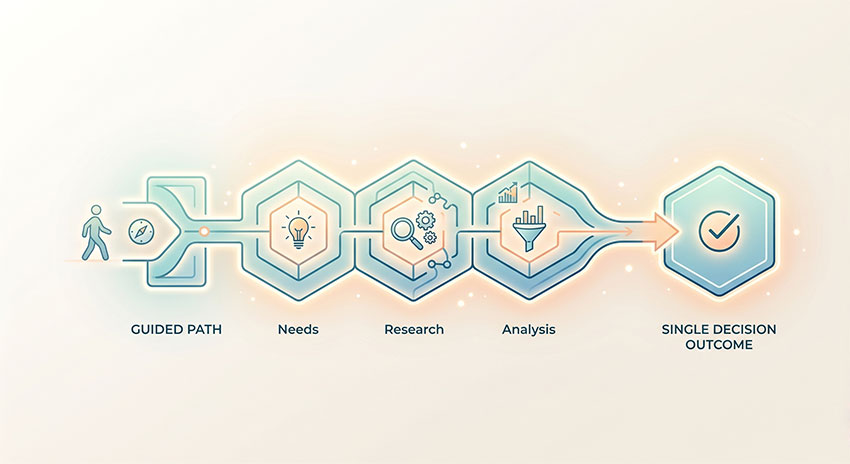
Final Thoughts: Your Link in Bio Is a Decision Architecture, Not a Traffic Container
A link in bio is not a traffic container—it is a decision architecture.
This aligns with modern UX and conversion design frameworks, where user experience is structured around guiding decisions rather than listing options.
In this model, social traffic is treated as intent-driven behavior flow rather than passive visits, which is why structured pages consistently outperform link aggregation tools.
Most pages fail not because they lack traffic, but because they fail to structure how decisions are made once users arrive.
Social traffic is already intent-rich, but extremely time-sensitive. If users are not guided immediately, that intent collapses.
This is why high-performing systems are not defined by the number of links, but by how clearly they define the next decision.
Everything else—funnels, layouts, CTAs—are simply implementations of this principle.